Agent solution
Give AI agents a comic generation tool with observable state.
Agents can call the Comic API through REST or MCP, retain the generation ID, monitor status, and pass returned assets into a review or publishing step.
The model may plan the story, but your agent must still expose cost, progress, failure, and user-review boundaries.
Connect an agent through MCPAccount, API key, usage, and billing open on LlamaGen.AI.
Direct answer
The decision this page is for.
Last verified:
Agents call Comic API through REST or MCP, keep the generation ID, monitor status, and pass assets into a later review or publish step. The agent must expose cost, progress, failure, and human review—not hide them in a loop.
Verifiable request
Agent tool request
{
  "tool": "create_comic_generation",
  "arguments": {
    "prompt": "Summarize the approved project brief as a four-panel visual story.",
    "fixPanelNum": 4,
    "language": "English"
  }
}
Structured response
State your application can route
{
  "generationId": "gen_abc123",
  "status": "QUEUED",
  "nextAction": "poll_generation_status"
}
Agent architecture
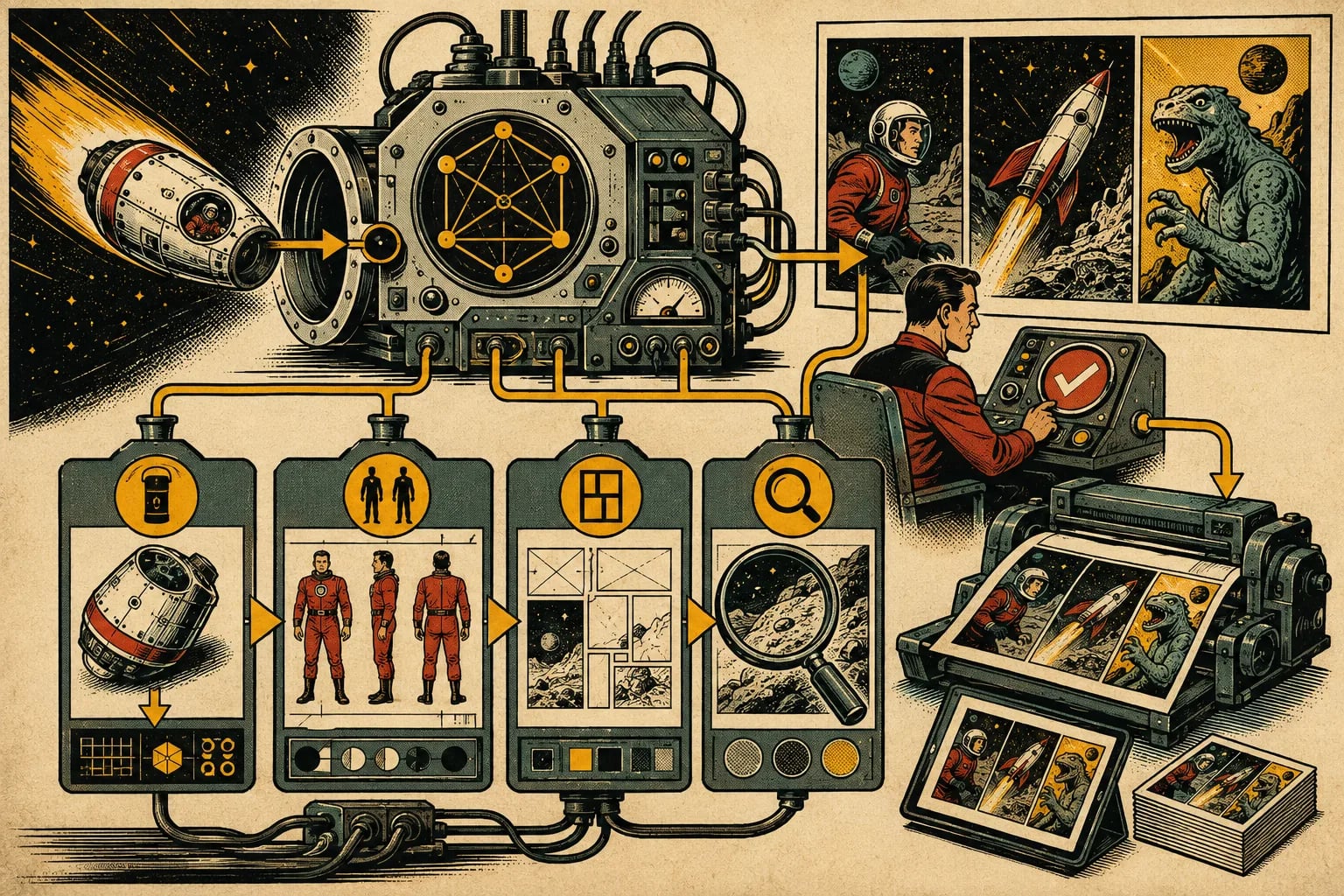
Give agents observable state, not a blind generation call.
The workflow shows a bounded tool request, persistent generation ID, state-aware follow-up, and a consumable visual result.
Capability and boundary facts
Facts an integration can verify.
Last verified:
- Interfaces
- REST and remote MCP
- Agent state
- Generation ID and lifecycle status
- Result
- Structured comic assets
- Human boundary
- Review before publishing or fulfillment
Good fit
Use it when
- Creative copilots
- Project recap agents
- Automated content operations with review
Wrong fit
Do not use it for
- Unbounded autonomous spending
- Silent failure handling
- Publishing without user or policy controls
Production limits
Plan for the boundaries.
- 01Agent loops need explicit budgets, timeouts, and maximum retry counts.
- 02Do not let an agent publish or spend without the controls appropriate to your product.
- 03Generation is asynchronous; production interfaces must handle processing and failure states.
- 04Outputs should be reviewed against product, brand, safety, and print requirements before delivery.
- 05You must have the rights to prompts, photos, scripts, and reference assets submitted to the API.
Authoritative sources
Questions
Direct answers before you integrate.
01What must an agent persist between tool calls?
02Can an agent publish automatically?
03REST or MCP for agents?
Next step
Move from evidence to a real API request.
LlamaGen provides the playground, API key, usage, billing, and authoritative service documentation.
Connect an agent through MCP