Location continuity guide
Keep recurring comic locations attached to the request.
The LlamaGen human documentation describes comicLocations as named scene or background references that can include an image URL for continuity across pages and panels.
Location references provide reusable context; they are not a deterministic background renderer. Review architecture, props, geography, time of day, perspective, and transitions in every output.
Inspect location reference guidanceAccount, API key, usage, and billing open on LlamaGen.AI.
Direct answer
The decision this page is for.
Last verified:
Keep a recurring setting attached to generation by using a stable comicLocations name and an approved, reachable environment reference. Then review architecture, props, geography, lighting, perspective, and transitions across every returned panel.
Verifiable request
Reuse one harbor station across a story
curl -X POST \
  https://api.llamagen.ai/v1/comics/generations \
  -H "Authorization: Bearer $LLAMAGEN_API_KEY" \
  -H "Content-Type: application/json" \
  -d '{
  "prompt": "The courier crosses the same harbor station at dawn and returns there after dark.",
  "fixPanelNum": 4,
  "comicLocations": [
    {
      "name": "Harbor Station",
      "image": "https://media.example.com/signed/harbor-station.webp?expires=1793240000&signature=example"
    }
  ]
}'
Structured response
State your application can route
{
  "id": "gen_abc123",
  "status": "LOADING"
}
Continuity walkthrough
Return to the same place without hiding the review work.
The location sheet and repeated panels make architecture, props, geography, time of day, and human continuity review concrete.
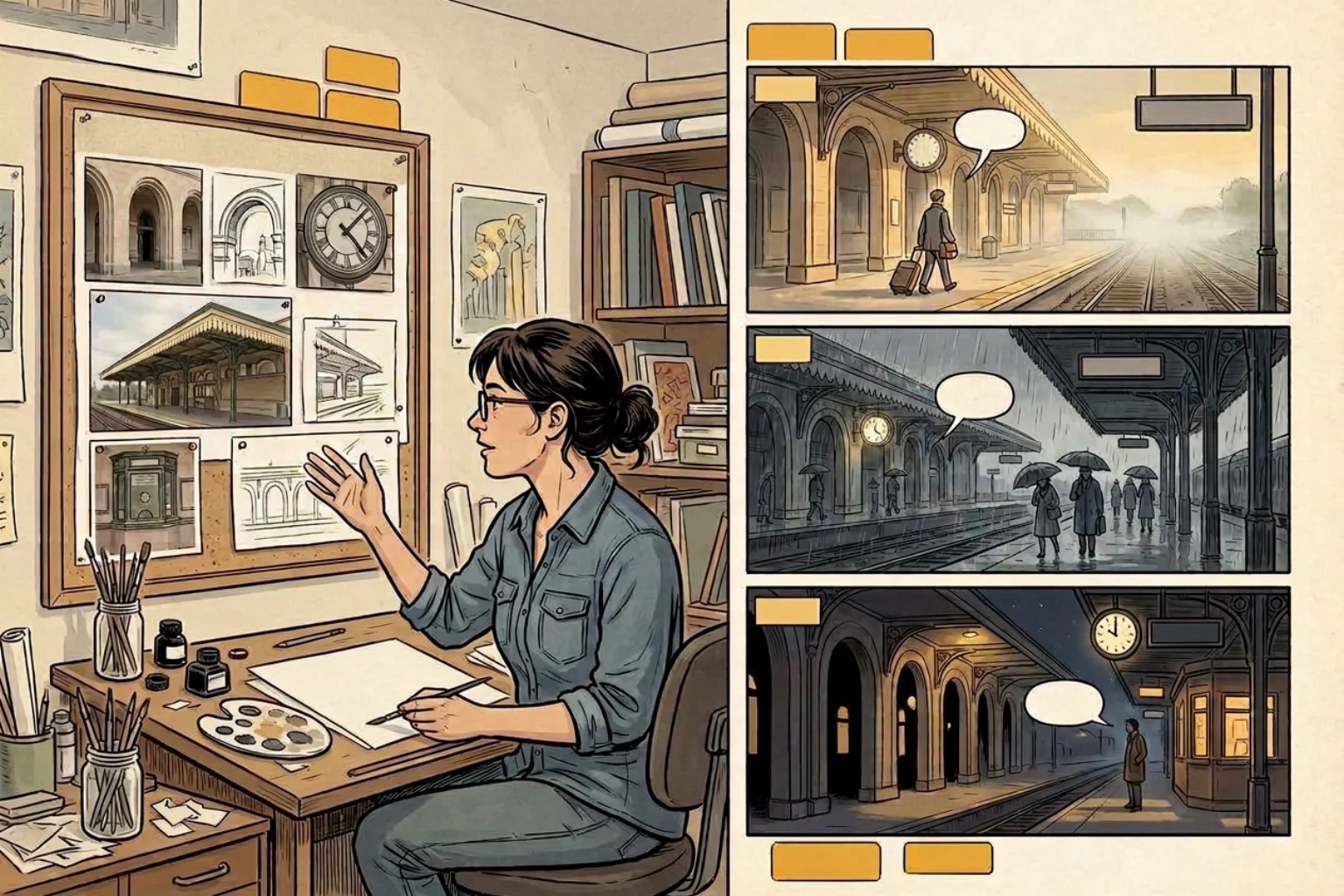
Environment continuity
Name the location, version the source, and review every return.
A recurring setting remains manageable when the creative team owns one approved location sheet and the application records which version each page batch received.
- 01Creator
Define the location
Record stable architecture, landmarks, props, palette, geography, and time-of-day rules in a location sheet.
- 02Art director
Approve a reference
Choose an owned environment image that communicates the details the story must preserve.
- 03Application
Name it consistently
Use the same stable location name and the current signed reference in the relevant generation request.
- 04Comics API
Generate a bounded batch
Keep the request small enough to compare repeated views of the setting in context.
- 05Reviewer
Audit continuity
Compare structure, props, geography, lighting, perspective, captions, and character scale across panels.
- 06Publishing system
Version the result
Archive the accepted location source and generation inputs before creating later pages.
Capability and boundary facts
Facts an integration can verify.
Last verified:
- Human-doc field
- comicLocations as an array or JSON string
- Stable identifier
- A reusable location name
- Optional reference
- An environment image URL
- Intended scope
- Visual continuity across pages and panels
- Verification
- LlamaGen human documentation and OpenAPI checked on 2026-10-29
Good fit
Use it when
- Serialized stories with recurring places
- Brand or product environments
- Page batches that need a visible location continuity review
Wrong fit
Do not use it for
- Deterministic 3D scene reconstruction
- Replacing a series bible or location sheet
- Skipping human review of backgrounds and transitions
Production limits
Plan for the boundaries.
- 01The human documentation describes comicLocations, but the current OpenAPI schema does not explicitly enumerate that field and instead permits additional properties. Treat the human guide as the source for this input and re-check before generating a strict client type.
- 02Location consistency is probabilistic. A named reference cannot guarantee identical architecture, props, lighting, scale, perspective, or geography.
- 03Use a signed, reachable asset URL and apply the same consent, rights, retention, and deletion rules as other reference files.
- 04The request is a documentation-shaped example; this page did not run a paid before-and-after location test.
- 05Generation is asynchronous; production interfaces must handle processing and failure states.
- 06Outputs should be reviewed against product, brand, safety, and print requirements before delivery.
- 07You must have the rights to prompts, photos, scripts, and reference assets submitted to the API.
Questions
Direct answers before you integrate.
01What does comicLocations provide?
02Is comicLocations in the OpenAPI request schema?
03Does one reference guarantee an identical background?
04Was the example validated with a paid before-and-after test?
Next step
Move from evidence to a real API request.
LlamaGen provides the playground, API key, usage, billing, and authoritative service documentation.
Inspect location reference guidance