Panel reference guide
Assign a reference image to one specific comic panel.
panelReferences maps one or more reachable image URLs to a zero-based pageIndex and panelIndex during the initial comic-generation request.
A panel reference guides the selected panel's scene, background, composition, or camera context. It is different from a character-wide reference and from PATCH regeneration after a panel already exists.
Review panel reference fieldsAccount, API key, usage, and billing open on LlamaGen.AI.
Direct answer
The decision this page is for.
Last verified:
Use panelReferences only on the initial generation request to map reachable reference-image URLs to zero-based pageIndex and panelIndex values. The reference guides one selected panel; it does not edit an existing panel or guarantee an exact visual match.
Verifiable request
Guide the third panel with a harbor reference
curl -X POST \
  https://api.llamagen.ai/v1/comics/generations \
  -H "Authorization: Bearer $LLAMAGEN_API_KEY" \
  -H "Content-Type: application/json" \
  -d '{
  "prompt": "A four-panel rescue at an original fogbound harbor.",
  "pagination": {
    "totalPages": 1,
    "panelsPerPage": 4
  },
  "panelReferences": [
    {
      "pageIndex": 0,
      "panelIndex": 2,
      "images": [
        "https://media.example.com/signed/harbor-wide.webp?expires=1793240000&signature=example"
      ]
    }
  ]
}'
Structured response
State your application can route
{
  "id": "gen_abc123",
  "status": "LOADING"
}
Reference walkthrough
Make the panel-to-reference mapping visible before generation.
One approved scene source sits beside the selected panel so the intended camera and environment guidance can be reviewed in context.
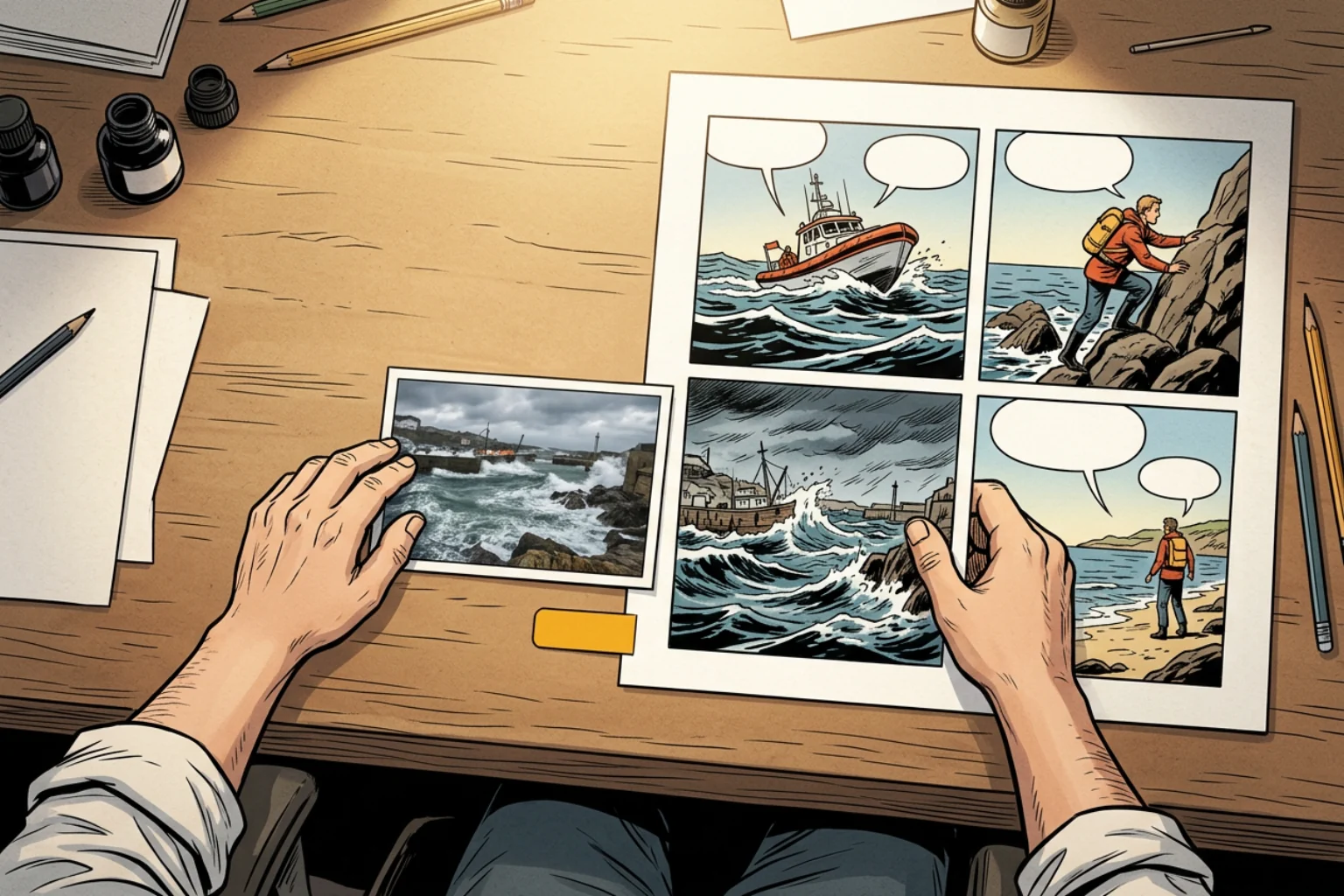
Reference mapping
Map one approved source to one intended panel.
The application should keep the private source, signed delivery URL, page grid, index mapping, and review outcome as separate records.
- 01Art director
Approve the source
Confirm rights, purpose, and the visible scene or camera detail the panel should borrow.
- 02Asset service
Create a signed URL
Expose the validated file only long enough for the generation request to retrieve it.
- 03Application
Resolve the index
Map the selected page and panel to zero-based pageIndex and panelIndex in the current request grid.
- 04Server
Create the comic
Submit the reference mapping with the initial generation body and persist the generation ID.
- 05Reviewer
Compare the result
Check the intended scene, camera, composition, character continuity, and neighboring panels.
- 06Publishing workflow
Revise selectively
Approve the panel or move the specific defect into the panel-regeneration workflow.
Capability and boundary facts
Facts an integration can verify.
Last verified:
- Operation
- POST /v1/comics/generations during initial generation
- Target fields
- Zero-based pageIndex and panelIndex
- Reference field
- panelReferences[].images as URL strings
- Documented scope
- Scene, background, composition, or camera guidance for the selected panel
- Verification
- LlamaGen documentation and OpenAPI checked on 2026-10-29
Good fit
Use it when
- Panel-specific establishing shots
- Product or location composition guidance
- Art-direction workflows with a reviewable reference map
Wrong fit
Do not use it for
- Recurring character identity across every panel
- Editing an already generated panel
- Making private source files permanently public
Production limits
Plan for the boundaries.
- 01The URL must be reachable by LlamaGen for the request window. Use a short-lived signed URL rather than exposing a permanent public customer asset.
- 02Zero-based indexes must match the requested page grid; validate them before submission so a reference is not assigned to the wrong panel.
- 03A reference guides generation but does not promise pixel matching, exact camera reproduction, or deterministic adherence.
- 04panelReferences applies to initial generation. Use the documented PATCH panel-regeneration workflow for an existing panel.
- 05The request and response are contract-shaped examples, not a recorded paid generation.
- 06Generation is asynchronous; production interfaces must handle processing and failure states.
- 07Outputs should be reviewed against product, brand, safety, and print requirements before delivery.
- 08You must have the rights to prompts, photos, scripts, and reference assets submitted to the API.
Questions
Direct answers before you integrate.
01Are panel reference indexes zero-based?
02Can I add panelReferences after generation?
03Should the reference image be public?
04Will the output reproduce the reference exactly?
Next step
Move from evidence to a real API request.
LlamaGen provides the playground, API key, usage, billing, and authoritative service documentation.
Review panel reference fields